Later Infancy: 9 Months
9-month-olds are more mobile and their vocalizations are becoming even more complex with the development of “reduplicated babbling” (ie. babbling with consonants). They are able to string together consonant-vowel sounds such as baba, dadada, gaga etc. In response to their baby’s more sophisticated language skills, it has been observed that many mothers naturally expand pauses between their verbal responses to give their baby time to respond.
By 10-11 months, “jargoning” emerges where it sounds as if they are talking. It’s as if the melody (sound and timing of speech) emerges before the lyrics (actual first words which typically emerge around 12 months).
Joint (Shared) Attention is becoming more complex and evolving from dyadic (attention between the pair), to triadic (shared attention with another to a 3rd object).
The development of shared attention follows a predictable timetable just like other milestones of infant development:
Dyadic Shared Attention Milestones (conversation like behavior between parent-baby)
- 6-10 weeks: Mutual Gaze – holding caregiver’s gaze with eyes widening
- 6 weeks: Social Smiling
- 3 months: Vocalizes when talked to
- 6 months: Listens, then vocalizes when adult stops
Triadic Shared Attention Milestones (Joint Attention between parent-baby and a 3rd object)
- 8-10 months: Gaze Monitoring – follows caregiver’s gaze to what they are looking at
- 8-10 months: Follows a point
- 8-10 months: Social Referencing – looking to caregiver’s facial expressions to decide what to do
- 9-10 months: Shows Objects to Share Interest
- 12-14 months: Points to get desired object (proto-imperative pointing)
- 14-18 months: Points to show interest (proto-declarative pointing
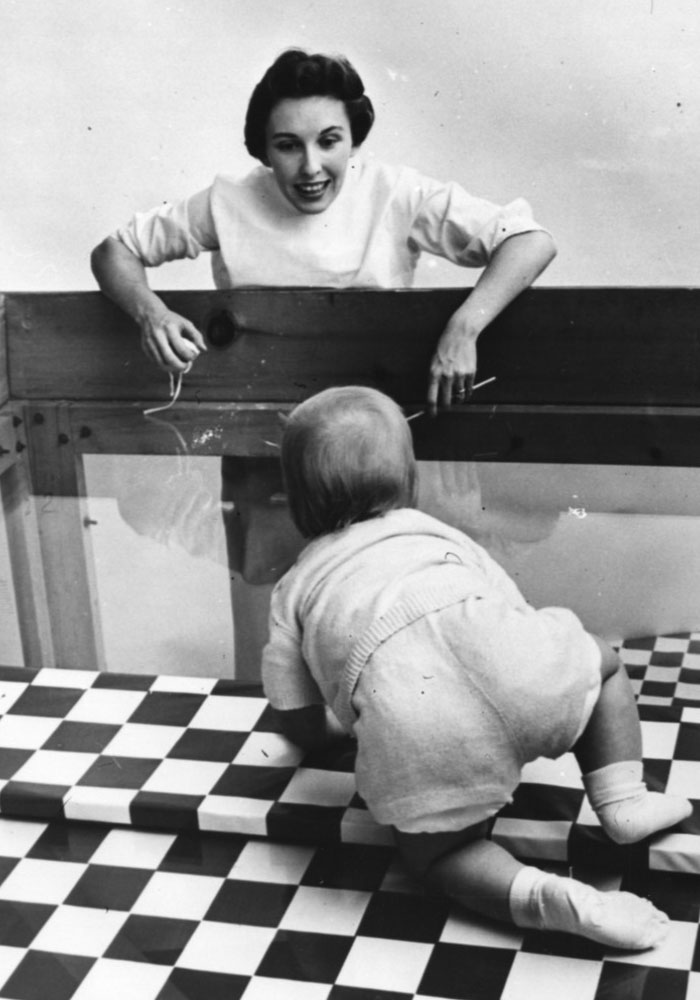
Social Referencing: This is a picture from the famous “Visual Cliff” experiment. Plexiglass was placed on one side of the table, to create the appearance of a drop-off. Infants in the study read the mother’s nonverbal facial expressions and crossed the plexiglass only if the mother’s face encouraged them to do so.
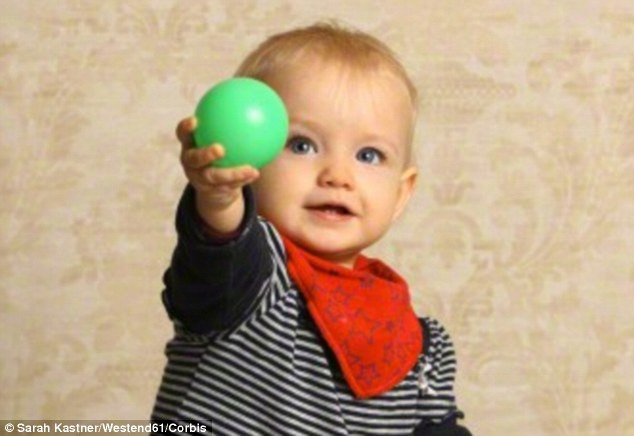
Showing Objects Milestone: During a visit, babies will often spontaneously show an object they are holding to their caregiver or the provider.
Shared attention is a critical part of language development. When parents share attention with their baby while commenting contingently about it at the same time, language is learned more readily.
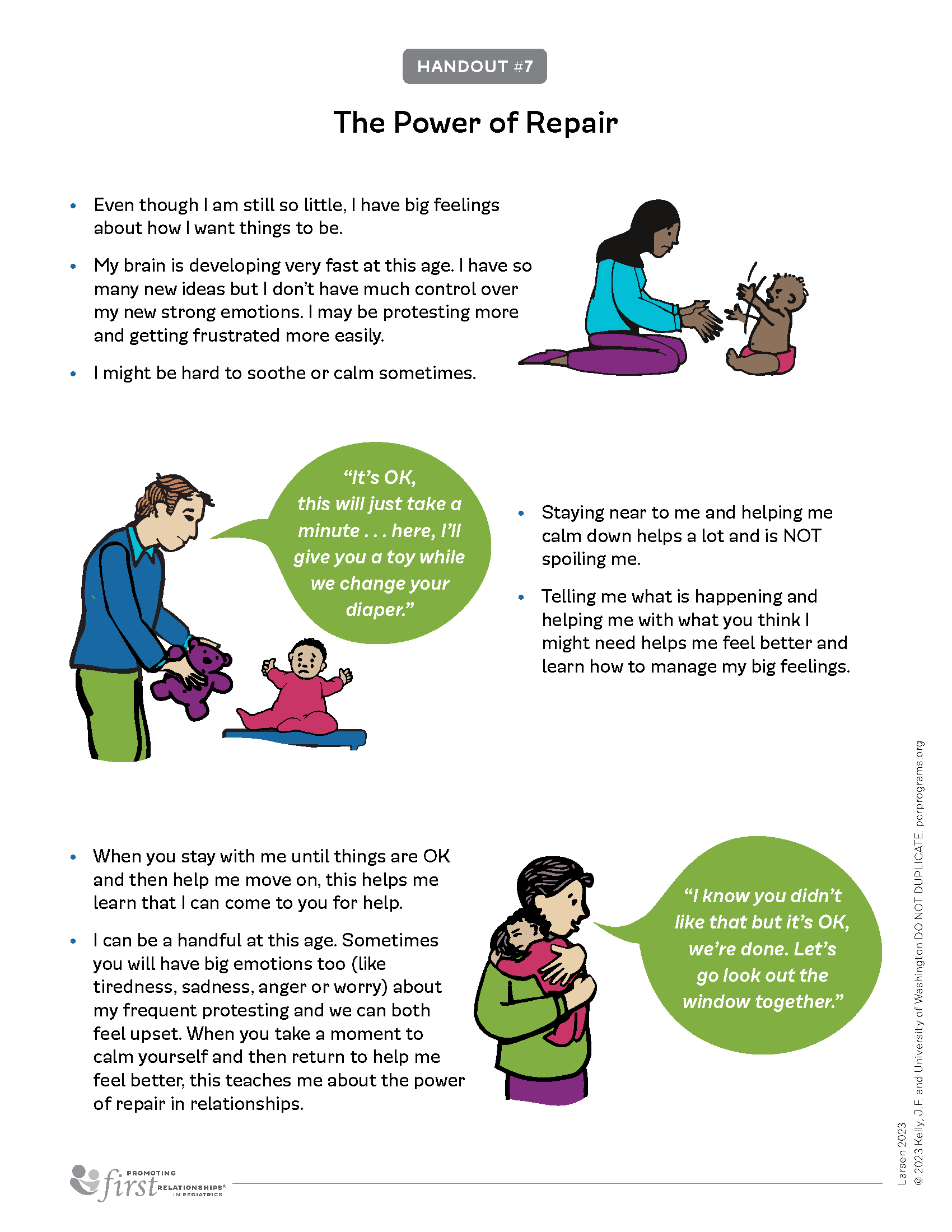
With these new developmental gains, babies have much more clearly defined ideas and protesting behavior when their ideas are not readily acted upon. These new bigger ideas and concurrent bigger emotions are a good sign of cognitive development.
Parents can help infants with their bigger emotions by re-directing, distracting and soothing. This is NOT spoiling and supports the infant’s own emerging capacity for emotion regulation.
Predictable routines help with emotion regulation. Much of a baby’s day is repetitive and habituated, i.e., feedings, transitions to naps/bedtime, getting dressed, getting in the car, etc. Predictable routines that go along with these activities helps babies feel safe and secure and anticipate what is next.
Handout #7 The Power of Repair is below.