
Qualities in the Parent-Child Relationship that Support Meeting Children’s Social-Emotional Needs
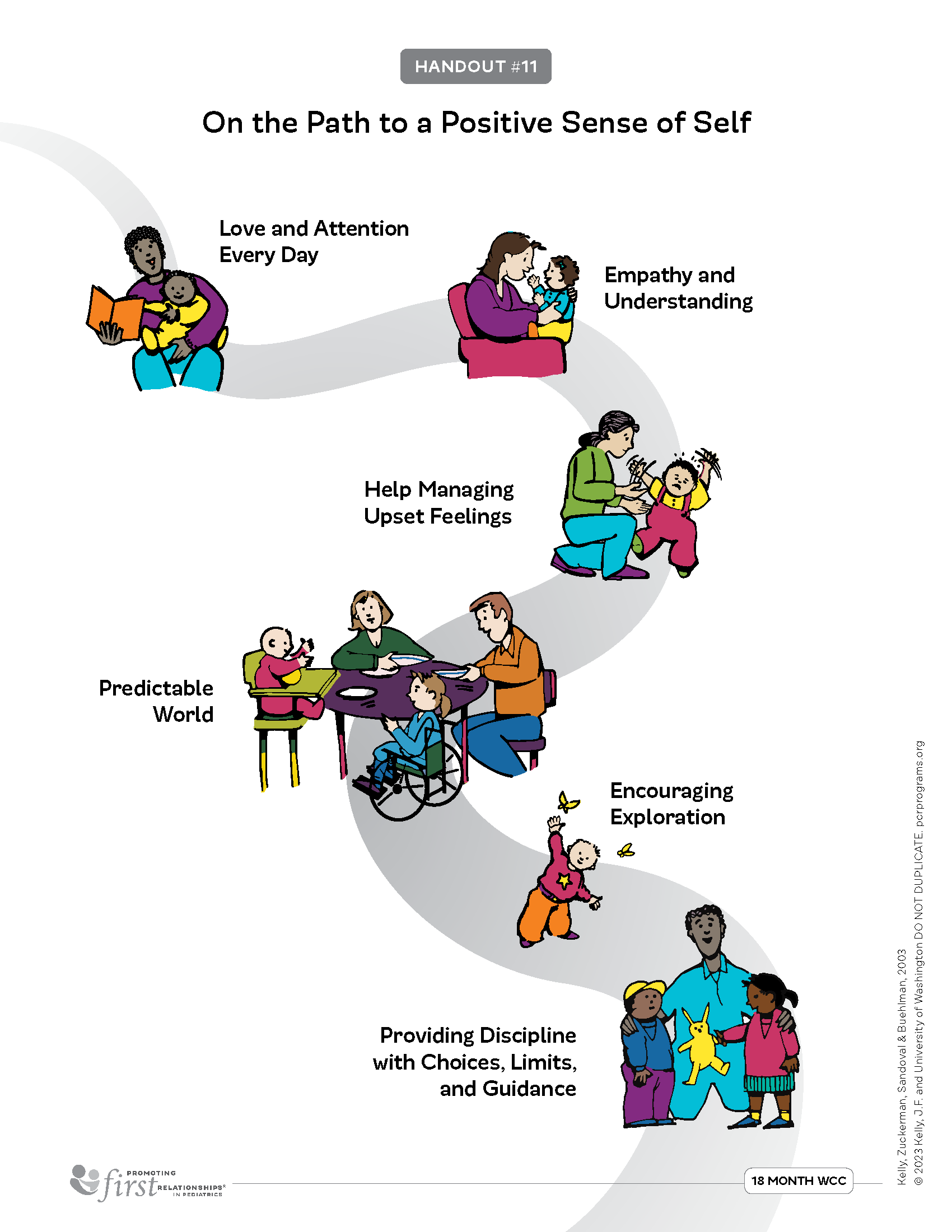
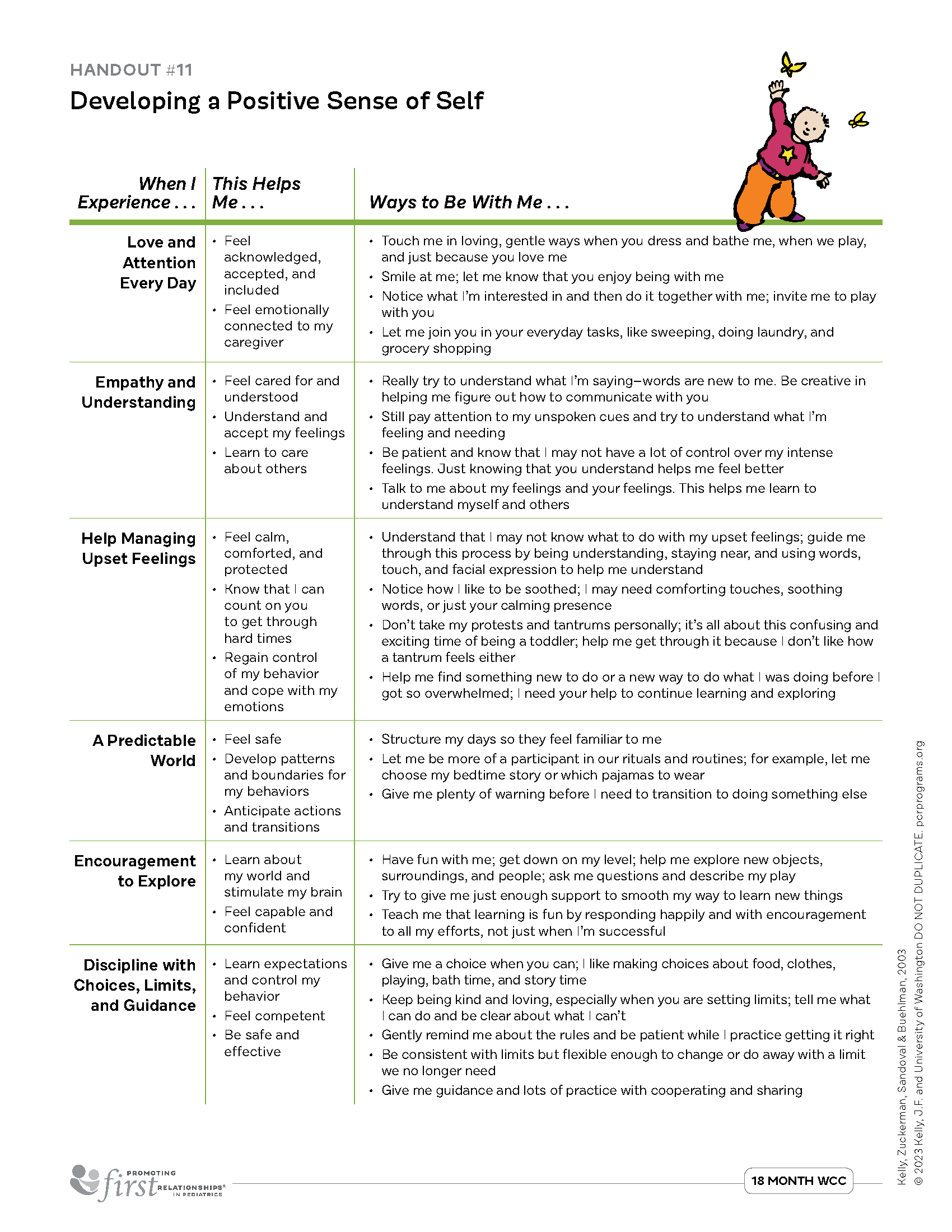
On the Path to a Positive Sense of Self describe qualities in the parent-child relationship that support meeting these social-emotional needs. A detailed explanation of this handout follows beneath the handout.
Explanation of “On the Path to a Positive Sense of Self” Handout
Love and Attention Every Day
Back and forth “serve and return” interactions are the fundamental building blocks of the parent-child relationship. They help the child feel seen and acknowledged and have a sense of belonging. Attunement and reciprocity in the relationship helps the child feel emotionally connected and safe and able to learn and explore.
Empathy and Understanding
When we feel understood and “felt” by another, it calms our shared nervous systems.
Interestingly, labeling and repetition are classic learning tools which are used all the time to teach toddlers abstract concepts such as colors, letters and numbers. Newer research is showing that it’s beneficial to do the same for learning about and managing emotions.
Labeling children’s emotions helps them make sense out of their feelings and helps them feel cared for. Giving children words for their emotions helps them categorize their feelings and helps them express their feelings with words and not just with their behavior, which ultimately helps adults and other children respond to their needs better.
Parents labeling their own emotions in the moment helps children learn to empathize with the parent and their other caregivers and peers. Labeling the child’s own emotions too in the moment also helps increase their ”emotion knowledge.”
Cooperation comes from empathy for another; the child or parent sees what the other needs and tries to work together. Cooperation is an important psychological need for toddlers.
Managing Feelings of Distress
Toddlers are beginning to learn self-regulation and inner control. They very much want to handle things on their own, but they don’t yet have the skills to control their behaviors and emotional reactions. They need an adult’s help to regain control and to learn adaptive ways to develop inner control. With this help, they will eventually learn to self-regulate.
When a child’s behavior is out of control, having tantrums, etc. this behavior is their “language of distress.” It is the only way that children can express the really uncomfortable feelings in their body which can be too much for them to manage by themselves at this age. They need their parents to be with them to help them calm down and return to what they were doing with a new option.
Being with children when they are distressed tells them:
“You can trust me that I’ll take your needs seriously. You can trust me to try to make things better. You can trust me with both good and hard feelings, and I will accept you and be available for you.”
When parents stay with their child until things are OK and help them move on, it tells the child that problems have solutions. The goal is for the child to learn self-regulation which comes initially from co-regulation.
Predictable World with Rituals and Routines
A predictable world gives children a sense of control and helps them to make sense out of their world. Routines decrease stress and help children anticipate what’s coming next and helps with transitions. Rituals also can prevent power struggles. Feelings of stress and anxiety from unpredictability lead to behavior problems
Encourage Exploration
Children gain feelings of mastery, independence, and positive self-esteem from exploring their world. Children need to have a sense of security with parents before they can confidently explore their world.
Parents need to be emotionally and physically available to sustain the child’s security. When children engage in limited exploration, it may be that the child is needing help to increase their security and exploration.
Discipline and Guidance
Another hallmark of a successful parent-toddler relationship is cooperation. Cooperating together is an essential part of relating to others. Connecting with others and having mutually enjoyable relationships is a psychological need. The goal of discipline and guidance is to help the child learn self-control and how to behave in socially appropriate and morally responsible ways.
Parents can provide a balance of limits, choices and guidance which gives the child a sense of power, control, and security.
- Limits help kids feel safe by putting boundaries on their exploration. A child trusts that the parent knows what they are doing when the parent confidently takes charge and uses consistent limits. Limits need to be flexible enough though to adapt to new situations and the child’s capabilities.
- Choices appeal to a toddler’s sense of fairness and need to control.
- Guidance is how parents use their wisdom with children. It’s important to remember that the world is new to the child. Exploring what they shouldn’t explore is normal because the child is following their natural curiosity (which is a good thing and comes from their increasing cognitive abilities.) Children need their parents to tell them what OK and not OK is over and over and over…as they learn about their world.