
2. Alleviation of Distress
The evolutionary adaptation to depend on social connectedness to keep us safe means that we have biologically linked nervous systems. Children are born ready to seek safety and protection from their parents. Infants and children especially need the regulating effects of the adult’s more mature nervous system. John Bowlby, the originator of attachment theory, theorized that every human comes into the world needing “a stronger, wiser other” to survive and thrive (Bowlby, 1988).
An essential element of responsive caregiving is being able to recognize when a child is in distress and to be able offer comfort and help to alleviate this distress. This emotion regulation provided by the parent to the child is called “co-regulation”.
Co-regulation is provided to the child when the parent is available to help regulate and contain the child’s emotions and help the child manage what they are feeling. Co-regulation occurs “when the mind and brain of the parents influences the mind and brain of the baby to help them regulate thoughts, feelings, perceptions and actions.” (Clark Baim, Attachment Based Practice with Adults). Co-regulation is dependent on the parent to be sensitive, responsive and a careful observer. There are many factors that both support and get in the way of responsive caregiving, including family, community and societal supports and injustices.
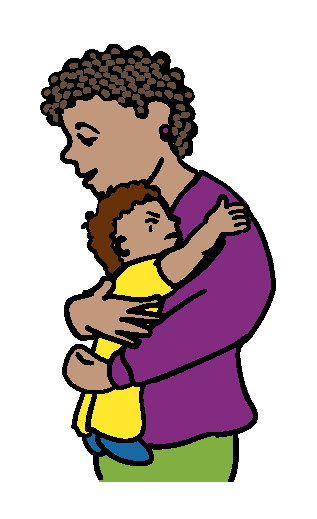
The first 3 years of life are a sensitive period for the development of emotion regulation. Parents who are able to respond quickly to their child’s distress build the child’s capacity to regulate their own physiology and emotions. Just like it is NOT spoiling to respond to a child’s cues, it is also NOT spoiling to help a child manage their emotions.
When parents feel effective at alleviating their child’s distress, they gain confidence in their parenting. Long term studies show that parental self-efficacy (feeling capable and confident) is linked to greater parenting satisfaction and connection with their child, even through adolescence.